iStick Pico review, still worth keeping years on
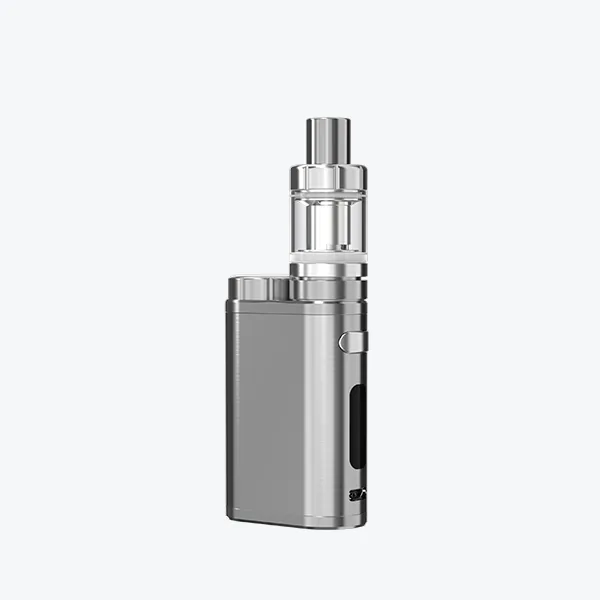
It still turns up in drawers, on shop shelves and in second-hand listings. The iStick Pico belongs to the handful of devices the market never really replaced. The question is no longer whether it vapes properly, but whether it still makes sense next to today’s pods, and whether the parts are still around. We brought it back into service for several weeks, with a fresh battery and an off-the-shelf tank.
Does the iStick Pico still hold up today
Yes, on one condition, which is accepting that you will look after a removable battery. On pure performance nothing has moved. Power goes up to 75 W, the resistance range runs from 0.1 to 3.5 ohm in variable wattage, and the 510 thread opens it up to almost every tank on the market.
What has changed is the context. A modern pod charges over USB-C, wakes up by itself and asks for no settings at all. Next to it, this box demands a battery, an external charger and a little curiosity. In return, it offers a lifespan that few pods ever reach.
Who the iStick Pico is really cut out for
This box mod is not for everyone, which is exactly what makes it interesting. Two profiles fit it clearly, and a third would do better to walk on by.
The vaper who wants a replaceable battery
This is the central argument. When the battery tires, you change the cell rather than the device. On a pod with a built-in battery, the same failure writes off the whole unit.
Eleaf also states a requirement that most retailer listings forget, namely that the 18650 cell must deliver a continuous discharge current above 25 A. A low-grade salvaged cell will not keep up when the power climbs.
A removable cell also changes how you travel. On a flight, the device and any spare batteries go in your cabin baggage only, never in the hold, with the spare cells protected against short circuits, and vaping on board is not allowed.
The vaper who already owns a collection of tanks
If you have three 510 tanks sitting in a box, this mod runs them all. Temperature control covers nickel, titanium and stainless steel plus three TCR curves, across a range of 100 to 315 degrees.
The vaper who wants to plug in and forget
This profile will be disappointed. Nothing here is automatic, and the first setup means reading the manual. You have to choose your wattage, watch the charge of the battery and take the tank apart to change the coil.
A pod with a replaceable cartridge settles those three points in a single move. On that ground the iStick Pico loses without argument, and it would be dishonest to claim otherwise.
What still works without argument
Three points explain why the device still sells on the second-hand market more than a decade after its launch. They owe less to the spec sheet than to design choices rarely copied since.
A format nobody has matched
At 45 x 23 x 70.5 mm for a box that takes an 18650 battery, it remains tiny. It disappears into a jacket pocket, which no dual-battery box allows. The stepped shape, with the tank set off to one side, avoids the usual top-heavy overhang.
Plain, readable electronics
Two buttons under the screen, simple logic and no nested menus. Setting the wattage takes three seconds. The display shows watts, resistance and charge level, without any frills.
Bypass mode deserves a mention. It switches off regulation and delivers the raw voltage of the battery. Few current devices still offer it, and it lets you recover the behaviour of a mechanical mod without the risks that come with one.
Full 510 compatibility
With a chassis 23 mm wide, the top plate accepts 22 mm tanks without overhang, the most common diameter for mouth-to-lung vaping. Beyond that size, the tank bites slightly over the edges without getting in the way of use.
What starts to grate after a few weeks
No device of this generation ages without faults. Those of the iStick Pico are known and documented, and they deserve a straight look before you buy one second-hand.
Micro-USB charging on early batches
The original versions charge over micro-USB, which in 2026 means keeping a dedicated cable to hand. Later batches moved to USB-C, but a second-hand listing almost never says so, so check the photo of the port before buying.
A battery cap that works loose
The threaded cap gains play over the months. Half a turn too far and the contact turns temperamental, with error messages that vanish as soon as you tighten it again. Nothing fatal, but it is the first thing to check if the device cuts out.
Paint and the fire button
Glossy finishes mark at the corners, and the very large main button sometimes fires in a pocket. Switching it off with five clicks on the fire button before putting it away solves the problem.
Our iStick Pico verdict, 16.6 out of 20
The score comes from our in-house grid, five criteria marked out of 5 then weighted. Endurance scores 4 out of 5 (30%), flavour 4 out of 5 (25%), handling 5 out of 5 (15%), leak resistance 3 out of 5 (15%) and perceived value 5 out of 5 (15%). Endurance and value pull the total up, while leak resistance depends mostly on the tank you screw on top.
Our verdict is to keep it. The heaviest criterion here remains the replaceable battery, which pushes the end of the device’s life well beyond that of a pod. Anyone after something simpler to live with should look at a power bank pod such as the Kiwi 2.0, which works in a radically different way.
Frequently asked questions
A few questions come back again and again, in shops and in our inbox. Here are short answers on points we did not cover above.
Which battery should you use in this box?
A branded 18650 cell with a continuous discharge current above 25 A. Cells sold without a readable reference are best avoided.
Can you leave it charging overnight?
The electronics cut the charge at the end of the cycle, but charging the cell in an external charger remains better for its lifespan.
How does it differ from the Pico Plus and the Pico 2?
They are evolutions of the same chassis, with different bundled tanks and a modernised charging port. The way you use them does not change.
What should you check on a second-hand listing?
The type of charging port, the state of the 510 thread and any play in the battery cap. Those three points decide what happens next.
Does it suit mouth-to-lung vaping?
Yes, as long as you fit a tank designed for it and stay under 15 W. In the UK, a tank used with nicotine e-liquid holds 2 ml at most.
What to remember before buying an iStick Pico
More than a decade on, the iStick Pico remains a sound choice for anyone who wants a device that is repairable, compact and compatible with anything that screws onto a 510 thread. In exchange it asks for a quality battery and a little attention to the cap.
Those who want a device that asks for nothing will go elsewhere, and they will be right to. The rest have in the iStick Pico one of the rare box mods still worth keeping after several years.
Related reading
- Our Aspire Nautilus review, one of the few 510 tanks still screwed onto this kind of box
- The Justfog Q16 Pro Plus after weeks of use, the all-in-one alternative for a tight draw
- The Innokin Zenith put to the test, to see what a modern tank adds
For adult readers. Vaping products containing nicotine, a highly addictive substance, may not be sold to under-18s in the United Kingdom. Our reviews are editorial and independent, and none of them is a buying recommendation.
More reviews to read
Geekvape Zeus review, which Z tank and coils to choose
15.4/20Our Geekvape Zeus review, from the Zeus Sub-Ohm to the Z Subohm 5, which Z coils to pick, the mod it needs and the score we gave it out of 20.
Lost Vape Centaurus BT200 review, what buyers report after unboxing
14.1/20Our Lost Vape Centaurus BT200 review, what buyers praise, three snags reported after purchase, where the listings disagree and our score.

Vaporesso GTX Go 80 review, what the listings really agree on
14/20Our Vaporesso GTX Go 80 review, what the maker and retailers say, the 2 ml UK pod, which GTX coils fit and the score we gave it out of 20.